 0
0
 0
0
When President Donald Trump approached the podium to introduce the American people to Operation “Epic Fury,” the plan was to neutralize Iran’s weapons and finish the conflict in about six weeks (whitehouse.gov). As we begin to approach the six-week mark, the fighting has become more intense, Iranians have become angrier, and Trump has displayed an exponential growth in confidence in his ability to win the war. His seemingly growing power trip has been displayed with vulgar and religiously offensive language.
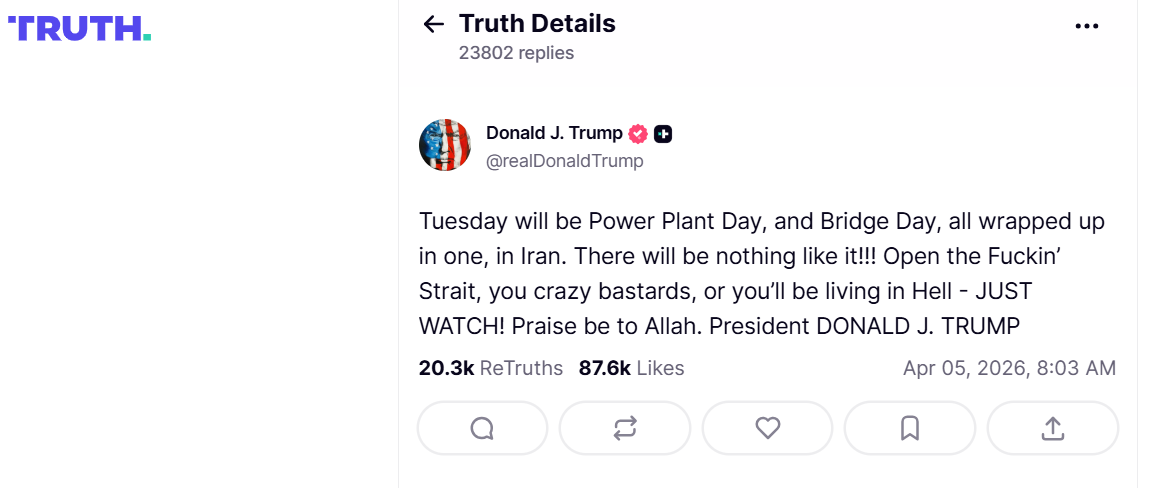
This post, which went live on Easter, contains clear and targeted offensive language towards the people of Iran. Many were also offended that Trump mentioned Allah, the Islamic god, in the same post as this foul language. This is usually where I’d add more commentary, but I think the post speaks for itself. I don’t have much more to say than that he didn’t show with his attitude. It’s a great example of Trump being willing to do whatever it takes to ensure that America, especially under his administration, to always be on top. This is also shown in another post, where Trump appears to be indifferent to the genocide of the entire country.
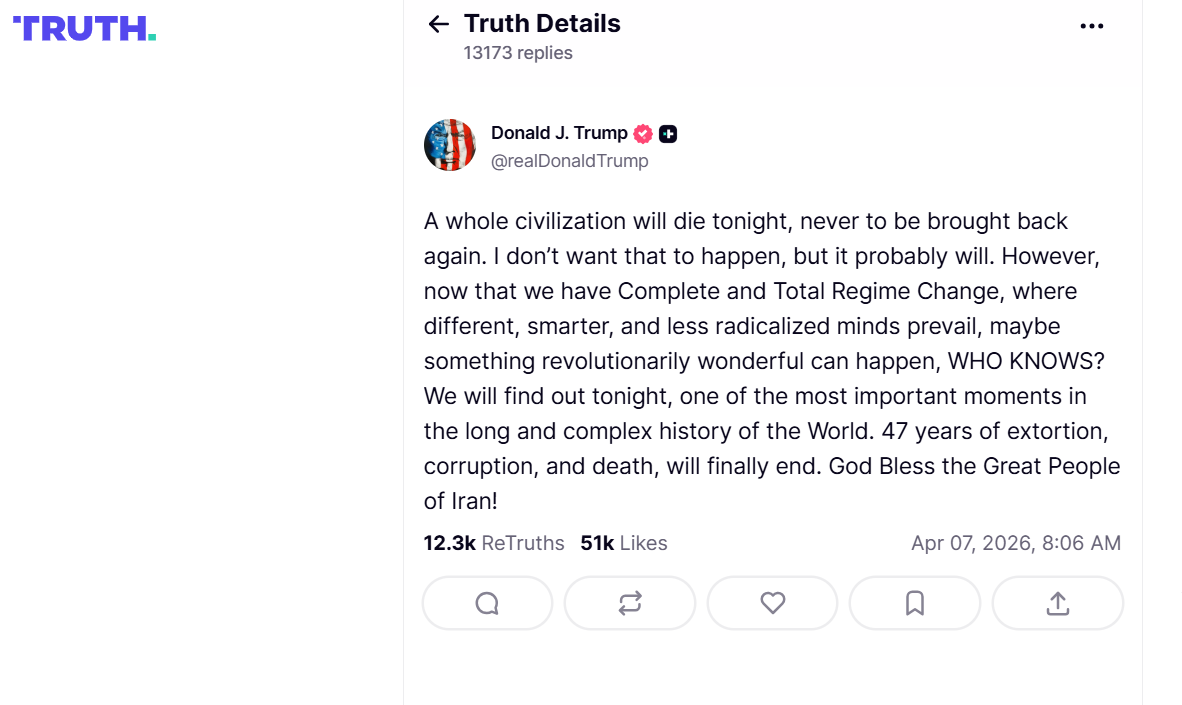
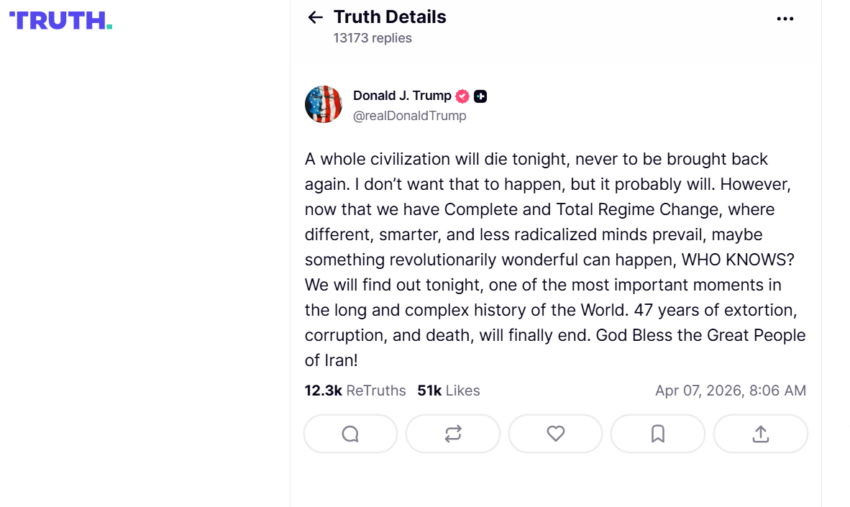
In this post and the last, there is a strange juxtaposition present that affects both posts. Trump claims, with unfit certainty, that the entire Iranian “civilization will die tonight,” and then finishes the post with “God Bless the Great People of Iran!” Not only is the indifference to the murder of an entire race horrific, disturbing, and borderline inhuman, but Trump does not even claim this ideology when he was the one who presented it. It is almost as though he is unwilling to take his own aggression against Iran seriously, as it seems to be diluted by the time he finishes the tweet with a blessing. It could be a psychological tactic to convince those that this is okay, it could be sarcasm, or it could just be sheer forgetfulness or carelessness. I don’t think we’ll ever know.
After reading such hateful language, now would be a good time to pause and attempt to figure out how so many people are willing and able to deal with this. Unfortunately, I believe the main answer, other than Trump’s supporters being okay with it, is to become numb to it, especially in our setting here at Avonworth. The Class of 2026, the current oldest in the building, was only (forgive me for this) six or seven years old when Trump’s campaign started. That leaves everyone else in the building as being only toddler-aged, with the middle school students being infants. For all of us, this is simply what politics have looked like our entire lives.
Nita Farahany, however, refuses to let time cover Trump’s actions. Farahany, a professor at Duke Law School, an Iranian American, and a micro-celebrity to the senior class, has been openly outraged and devastated by Trump’s operation.
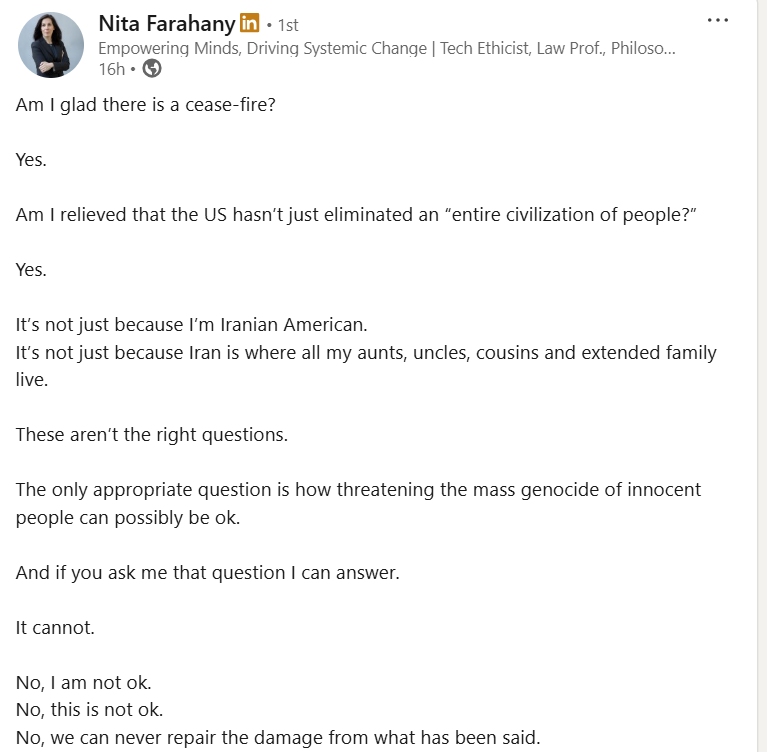
Farahany makes an important point: you don’t need to be directly connected to the war to care about what is happening. It can be difficult to empathize with those in war-torn countries, but the important thing is recognizing the horror and sheer agony, even if you cannot relate to it. Where I do disagree is the end of her post: “we cannot repair the damage from what has been said.” I’m not an Iranian-American, so I can’t properly speak to the true effect Trump’s words have had on Iranians, but I do not believe that any action or phrase is completely irreparable to an entire community. I do not believe that any one person has enough power to dismantle an entire, century-old community, and that speaking out against him has much more power than discussing the damage that has been caused.
Other Trump supporters have taken to shifting blame to symbolism— as in, referring to Trump as a symbol of their beliefs and desired actions as opposed to a person. Anthony Scaramucci, a Republican and former communications director for the White House, once told reporters that America “should definitely take him [Trump] seriously because he’s a man of his word, but […] I think his supporters see that more as symbolism” (Politico). This quote is from almost a decade ago, around the beginning of Trump’s first term, but in 2026, what would Trump be a symbol of? Furthermore, what do his supporters want him to be the symbol of?
Today, I don’t think “Make America Great Again” members have a genuine answer to that question. Instead, I believe that many of them use this idea to shift blame away from themselves for supporting him. It reminds me of excusing someone’s abusive behavior because “that’s just how they are.” If they view Trump as a symbol of their beliefs instead of a genuine man who genuinely holds these beliefs, then they don’t have to sit with the discomfort of supporting a politician who is openly for genocide, hatred, and vulgarity. Trump does have supporters who share the same ideology as him, but for those who don’t, dehumanizing him is the only way to continue the charade.
So, what DO we do with Trump’s hateful words? Like I said, attempting to break the numbness we feel is a great start. It can be hard to do so, but the most important thing is remembering that the people in the Middle East are real people, and we have the power to stand up for them in a first-world, democratic country. We have the power to stop this war if enough of us protest against the brutality. We can turn our anger into power if we remember why we fight.