 0
0
 0
0
Nationwide protests have erupted across France as students and teachers demand increased education funding, improved classroom conditions, and immediate solutions to teacher shortages.
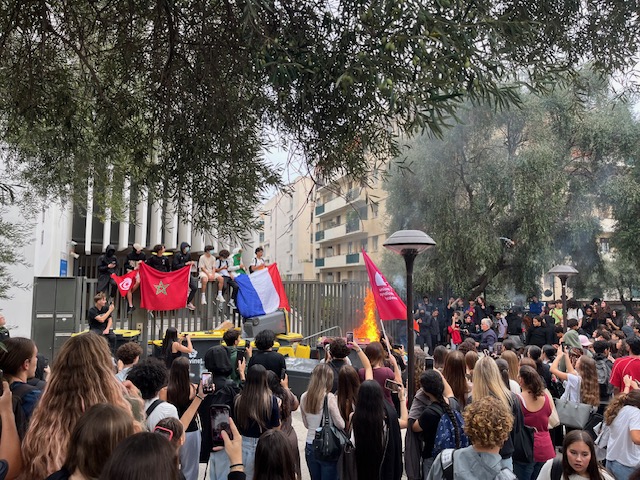
Former exchange student in 2024-2025, Brune Jico shared photos and comments from outside her school during the early days in October 2026.
“It is actually one of the biggest movement since a long time in France all the country is impacted and almost every high school.However the government is for the moment not really reacting and workers, firefighters and other community are joining the movement.They actually closed a big amount of schools last week due to “the lack of security” but they actually don’t really want us to speak because they know it can engender a lot bigger problem for them”
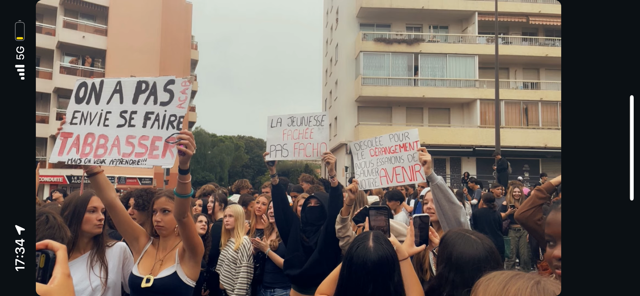
Most students here mirror sophomore Jocelyn Grande’s statement, “I don’t know anything about that.” In contrast, history teacher Mrs. Maisner acknowledged the underlying crisis: “All of those things and problems, but I’m not sure that protesting is the answer—but at least it is bringing attention to the issue.”
After another day of protesting on October 7th, Brune sent a more detailed overview of the events:
Today was another day of protesting, but because of the heavy rain, the protest did not bring everyone together.
Regarding the flags in the photo — Moroccan, Algerian, Tunisian and Palestinian — some students from my school brought them as a way of representing and recognizing their communities. Many immigrants in France come from North African countries, for example. However, I really believe that they deserve to be treated like all other French people, and I think their causes are extremely important, especially with the rise of the far right around the world.
That being said, we all know that displaying a national flag during this type of protest, sometimes in front of fires or during violent situations, can unfortunately hurt the cause they are trying to defend. Some people do not realize that proudly displaying their flag can later be used against their communities, especially when the media presents foreigners as being responsible for the problems. Thankfully, some Algerian, Tunisian and other members of these communities understand how harmful this can be and warn others about it. Even some parents and adults from the same communities talk about this with younger people.
When I saw people displaying their North African flags, I immediately told a girl with a French flag to give it to them, because I wanted to make it harder for the media to portray “foreigners” as the problem. Sorry if I am being very precise about this, but I wanted to make my response as clear as possible and avoid leaving anything out that could later be misunderstood or turned into a false rumor.
The topics of the protests are actually very diverse. Some schools are mainly protesting because of local problems with their buildings, funding or staff… schools in disadvantaged suburbs are more likely to lack teachers, and their students do not always receive the same quality of education as students in wealthier areas. The government does not seem to care about these schools as much as it does about schools in richer areas. Obviously, this is not only a French problem.
At my school, we are mainly protesting to support students in these disadvantaged schools. We are not in a big disadvantaged area ourselves; we are in a relatively privileged region of France but my schools is definitely the most diverse in the area. However, I personally protest mostly because of the government’s reforms: Parcoursup, changes to the mathematics exam, phone restrictions, and the new spelling rules for graduation exams.
Individually, none of these reforms may seem completely unreasonable. But the accumulation of all these reforms is what frustrates us. It sometimes feels like the government wants to introduce reforms simply to appear active and modern compared with other countries or political parties, without really thinking about how they will work in schools, what their consequences will be, or even what the original causes of the problems are.
Finally, I would say that the best way to support French students is to talk about these issues, stay informed, do your own research, and form your own opinion. We are tired of people telling us that we are violent or that immigration is the problem. What gives me hope and courage to continue is receiving messages like yours from people who genuinely want to understand and who ask questions directly to the students concerned.


